Incident Overview
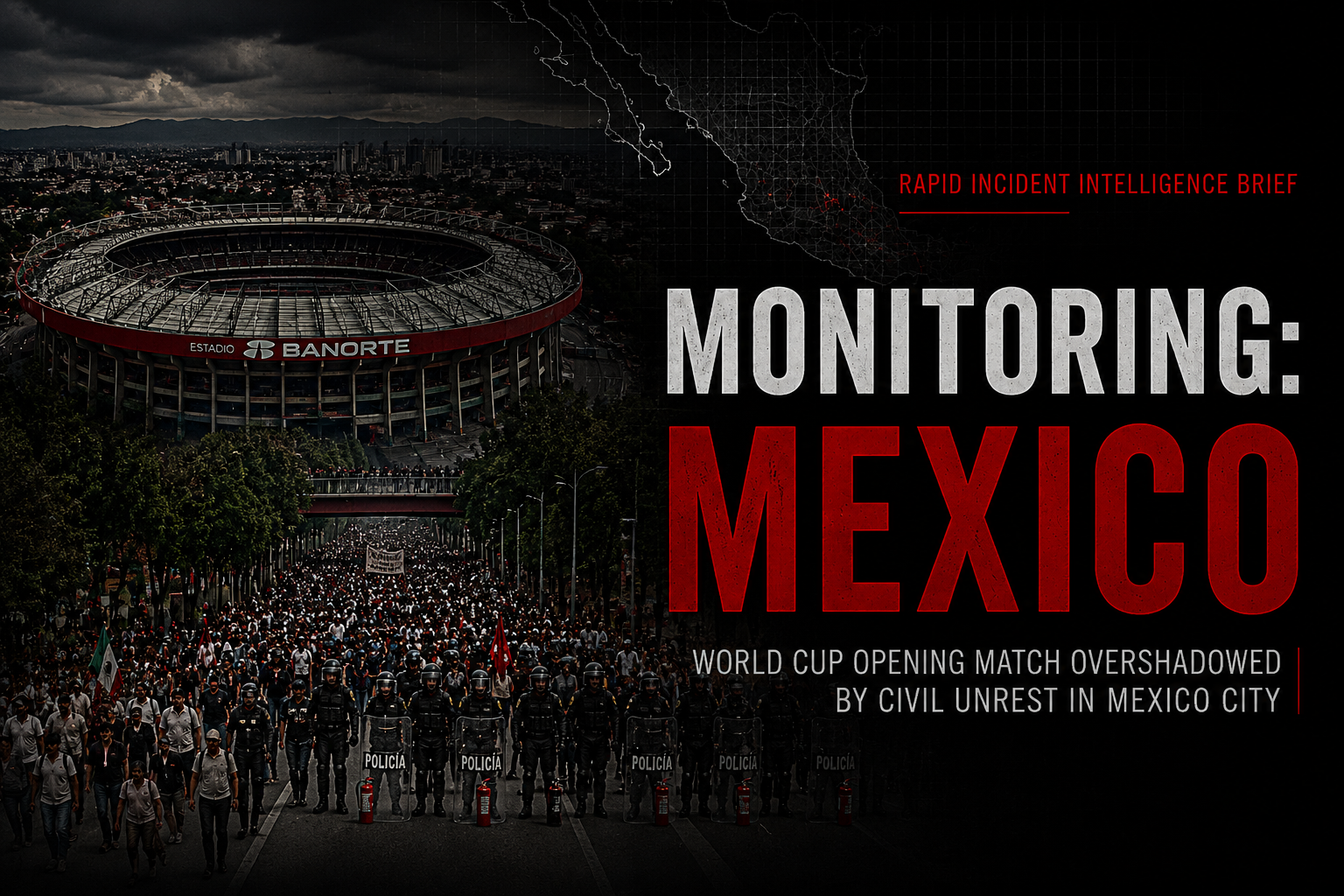
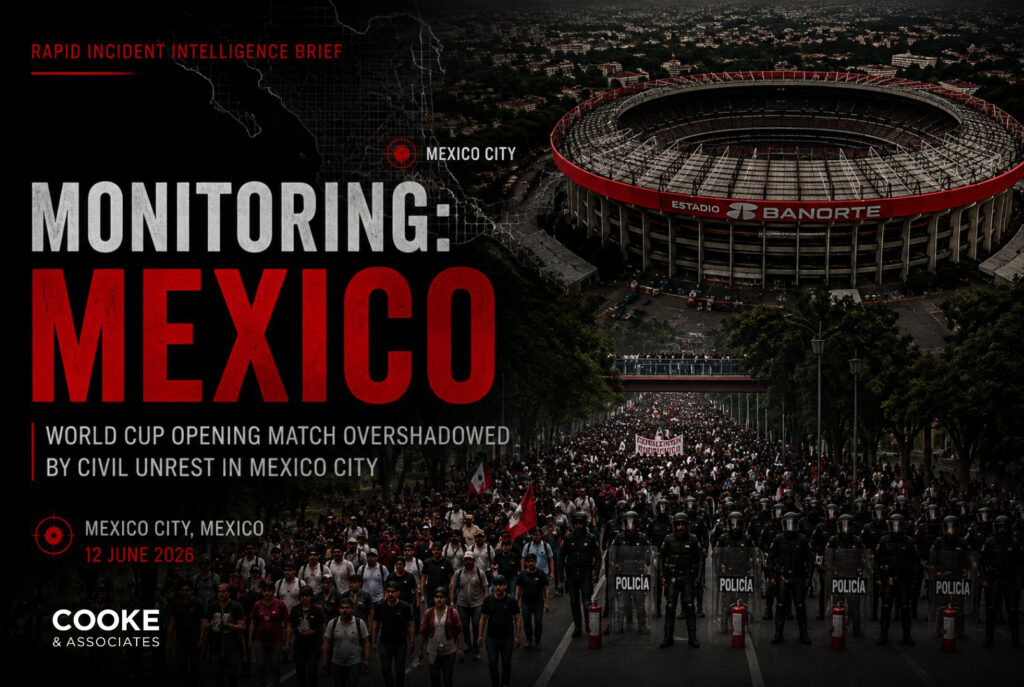
At least six separate protests were planned and active in Mexico City on 11 June 2026, coinciding with the opening match of the FIFA World Cup at Estadio Azteca between Mexico and South Africa. Two distinct protest groups were confirmed active: families of missing persons linked to cartel violence, and dissident teachers from the National Coordination of Education Workers (CNTE). Clashes between protesters and police occurred at and near Estadio Azteca and in central Mexico City against a backdrop of sustained social tensions in the capital that predated the tournament. Concurrent confirmed lethal cartel attacks on police were reported in a separate cartel-affected Mexican state during the same reporting period. While geographically distinct from the Mexico City unrest, these incidents reflect a broader pattern of elevated security pressures across Mexico during a period of heightened national and international attention tied to the World Cup.
Key Details
Location: Estadio Azteca and central Mexico City, Mexico, including the Zócalo plaza area and the capital’s main avenue corridor. Date and time of incident: 11 to 12 June 2026, with protest activity confirmed from at least the evening of 11 June and continuing into 12 June 2026. Incident type: Civil unrest and public disorder, including confirmed protest-police clashes involving multiple organized groups. Opening match: Mexico versus South Africa, Estadio Azteca, 12 June 2026. Official holiday: Thursday 12 June 2026 was declared an official public holiday in Mexico City, in part to manage transportation and crowd flow concerns related to the opening match. Confirmed casualties and impact: Casualties have not been confirmed at this time. The full scope of injuries or arrests remains under development. Confirmed parties involved: Families of missing persons, CNTE dissident teachers, and Mexican law enforcement personnel at and near Estadio Azteca and the Zócalo area. Cartel actors and police forces were separately involved in confirmed lethal attacks in another Mexican state during the same reporting period.
Operational Impact
Active clashes between protesters and law enforcement at Estadio Azteca and in central Mexico City are producing confirmed access disruptions in and around the venue area and the broader city center. Road closures, elevated law enforcement presence, and restricted pedestrian and vehicle movement in affected zones are expected as authorities manage crowd control and event security simultaneously. Thousands of CNTE teachers were confirmed marching from approximately three miles from Estadio Azteca toward the stadium ahead of the opening match, compounding access pressure in the corridor between the city center and the venue.
The Zócalo plaza, designated as the primary free fan festival venue for the opening night, was subject to an active teachers’ encampment for multiple days leading into the opening match. Authorities erected barricades at the plaza entrance and subsequently confirmed the fan zone would open, with 18 alternative viewing venues identified as contingency locations. Businesses along the capital’s main avenue erected steel barricades in anticipation of potential unrest, reflecting a confirmed ground-level security posture consistent with elevated disorder risk in commercial corridors.
Travelers holding event tickets or with accommodations in proximity to the stadium or central city areas should anticipate significant delays and limited access to normal transit routes. Aviation operations at Aeropuerto Internacional Felipe Angeles and Aeropuerto Internacional Benito Juarez are not confirmed as directly affected at this time, though ground transportation to and from both airports may be impacted by road conditions and law enforcement activity in and around the city center. The simultaneous occurrence of a high-profile international sporting event and multiple active protest actions is placing compounding pressure on public safety resources throughout Mexico City.
Emergency Response and Government Actions
More than 100,000 soldiers, sailors, National Guard members, and police officers have been deployed across the three World Cup host cities of Mexico City, Guadalajara, and Monterrey. This deployment level reflects a significantly elevated security posture established in response to violence that paralyzed host city Guadalajara in February 2026. Mexican President Claudia Sheinbaum publicly stated that the situation was under control. Authorities confirmed the Zócalo fan zone would open despite the teachers’ encampment, with 18 alternative fan viewing venues designated as contingency locations. Thursday 12 June was declared an official public holiday in Mexico City in part to alleviate transportation pressure during the opening match period. A number of government officials engaged directly with the families of missing persons march, advising participants they could advance only to within the final mile of Estadio Azteca.
What This Means on the Ground
Central Mexico City is operating under compounding disruptions. Protest marches, law enforcement deployments, road closures, and business barricading are simultaneously affecting mobility and access across key areas of the city. The Zócalo area and the avenue corridors approaching Estadio Azteca are the primary zones of disruption. Normal pedestrian and vehicle movement patterns through these areas cannot be assumed for the duration of active match and protest activity. Individuals with business, residential, or transit requirements in central Mexico City should plan for extended delays, reduced access to standard routes, and the potential for rapidly changing conditions at intersections of protest and event activity.
Timeline of Key Events
Several days prior to 11 June 2026: CNTE dissident teachers establish an encampment outside the Zócalo plaza, blocking access to the designated fan festival venue and disrupting World Cup installations in the capital. Evening of 11 June 2026: More than 1,000 relatives of missing persons march through Mexico City toward Estadio Azteca carrying candles and photographs. Government officials engage the march and limit advance to within the final mile of the stadium. 11 June 2026: President Sheinbaum acknowledges the Zócalo fan zone cannot be guaranteed due to the teachers’ encampment and confirms 18 alternative venues. 12 June 2026: At least six protests confirmed active in Mexico City. CNTE teachers march from approximately three miles from Estadio Azteca toward the venue. Clashes between protesters and police confirmed at and near Estadio Azteca and in central Mexico City. Authorities confirm the Zócalo fan zone will open. Mexico versus South Africa opening match proceeds at Estadio Azteca. Concurrent, separate location: Confirmed lethal cartel attacks on police reported in another Mexican state during the same reporting period.
Security and Travel Implications
Aviation operations at Mexico City’s two international airports are not confirmed as directly affected. Ground transportation to and from both airports through the city center should be treated as potentially disrupted due to road closures, law enforcement deployments, and active protest movement along major arterial routes. The declaration of an official public holiday in Mexico City may affect the availability of some commercial services and transport options. Travelers in or transiting through central Mexico City should avoid protest corridors, maintain contingency routing options, and monitor law enforcement guidance in real time. World Cup event corridors between the city center and Estadio Azteca represent the highest concentration of access risk during active match and protest periods.
Short-Term Risk and Near-Term Outlook
Risk Level: Medium. Confirmed protest-police clashes, multiple active organized protest groups, and a high-density international event environment present credible and immediate disruptions to mobility, access, and personal safety for individuals operating in or transiting through affected areas of Mexico City.
Assessment
The convergence of the FIFA World Cup opening match and sustained pre-existing social tensions in Mexico City has produced a confirmed public disorder environment involving multiple organized groups with distinct grievances. The scale of the security deployment, exceeding 100,000 personnel across three host cities, reflects the severity of the threat picture authorities were managing entering the opening match period, including lessons drawn from the Guadalajara violence in February 2026. The current unrest is assessed as disruptive to mobility and access rather than indicative of a collapse of public order, but conditions remain fluid and the concentration of protest activity in central Mexico City and around Estadio Azteca creates meaningful risk for individuals operating in those areas.
The near-term risk is centered on continued access restrictions around Estadio Azteca, the Zócalo area, and adjacent central Mexico City corridors. Law enforcement resources will remain heavily allocated to World Cup venue security, which may affect response capacity and timing in surrounding areas. The concurrent cartel-related lethal attacks in another state, while geographically separate, signal an elevated threat environment across Mexico during this period and should be factored into travel and operational planning for individuals moving outside of Mexico City. Personnel and travelers operating in or near protest zones or World Cup event corridors should maintain heightened situational awareness and have contingency routing options established.
Outlook
Near-term stabilization around Estadio Azteca is possible as the opening match concludes and law enforcement consolidates crowd control measures. However, the CNTE teachers’ protest infrastructure has been established across multiple days and is not expected to dissolve immediately following the opening match. Additional unrest during subsequent World Cup events in Mexico City cannot be ruled out given the organized and sustained nature of the protest activity observed in the lead-up to the opening. The cartel threat environment in other Mexican states is not expected to diminish in the near term and should be treated as a sustained operational consideration throughout the tournament period.
GSOC Advisory
The CAI GSOC is actively monitoring this situation and will continue to provide updates as new information becomes available. Cooke & Associates is supporting clients in the affected area and providing guidance or assistance as needed. Individuals in the affected area who are not current clients and require assistance are encouraged to contact the GSOC or a Cooke & Associates representative for support.